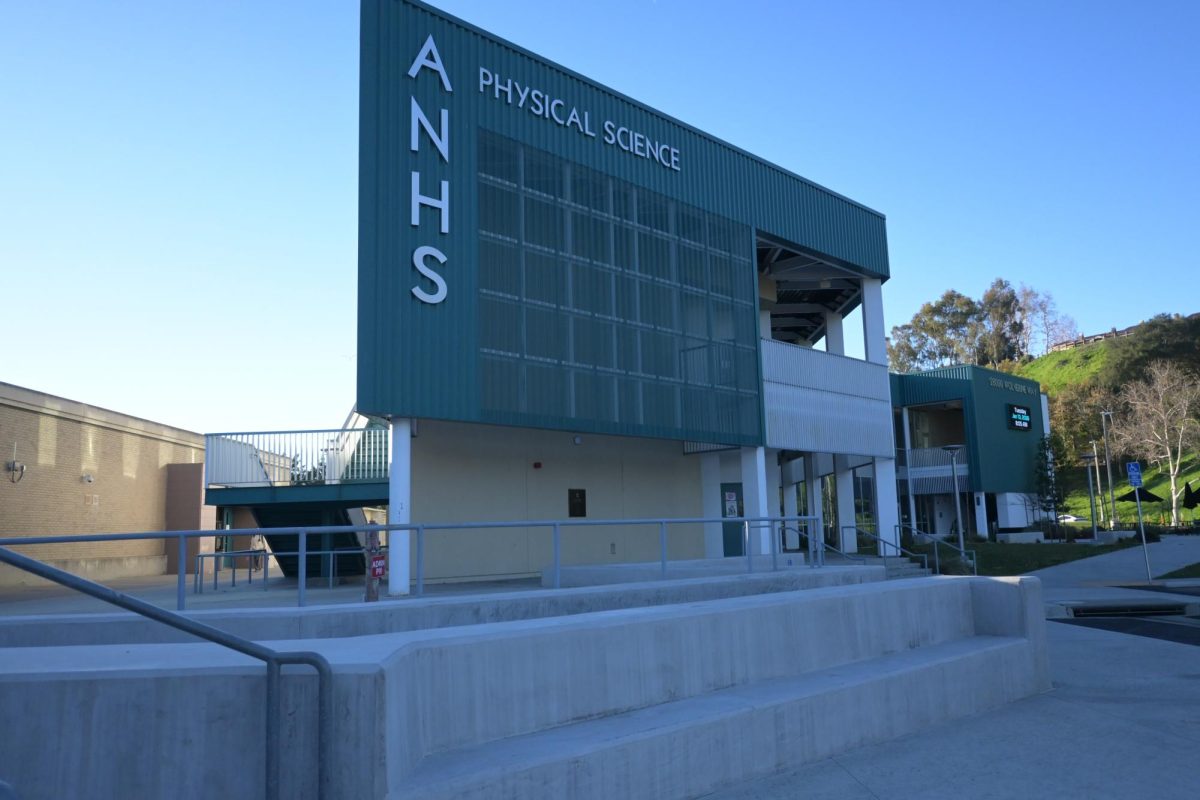
In an especially severe case, rooms S203 and S103 in the S.T.E.M. building experienced a water leak during the heavy rainfall of winter break. The incident caused a few damages in teaching equipment, but further implications of the leakage on the building itself are not clear at this time.
Winter break had brought an unexpected amount of rainfall that fell through the ceiling of the S.T.E.M. building, bringing water into room 203, Mr. Lau’s AP Physics 2 classroom, located on the second floor of the building. The leakage only happened in one spot over a table installed to the left of Mr. Lau’s main desk, causing minor water damage to it.
The volume of water was large enough to even drip down through the classroom’s floors and into the room just below it, which is Mr. Mosier’s classroom for AP Physics 1 and Marine Ecology. Although much less water was reported in Mr. Mosier’s classroom, the water landed on his desk and broke his document camera – a tool he frequently uses during his lectures.
Mr. Mosier said, “I [went] to turn on my projector, and it didn’t work because the document camera… was soaking wet. I lifted it up, and the water was pouring out.”
Thankfully, Mr. Mosier was able to get his document camera replaced by the school.
When issues such as water leakages appear on campus, or other tasks requiring management occur, work orders are created to make a pending list of tasks to complete. Each of these formal requests has different priority levels, and some requiring more expertise or specialized equipment than our custodians have will require workers from the district to come assist.
In this case, a work order was equally filled out and was sent to the district for revision before people arrived to assess the situation.
One of the school’s assistant principals, Ms. Hosseini, amongst many other tasks, manages infrastructural issues with the school and helps facilitate work orders; although work orders are issued by another administrator in the student services department.
A specific date for reparation and the time for reparations are unknown, but Ms. Hosseini has stated that work orders have always been a common, efficient, and effective system for addressing concerns, especially in her experience.
The S.T.E.M. building was built in 2022 with a budget of around $11.5 million dollars, and since its construction, there have not been major safety concerns in the S.T.E.M. building, but it does have a history of water leaks.
The leaks in Mr. Lau’s room have been recurring. Mr. Lau has been in the s203 for two years, and small water leaks from, especially, two spots have been recurring.
Mr. Lau said, “There were days when I knew it was going to rain, so I pushed the table aside and left a bucket [where the leak happens].”
The problem had been addressed in the past, but only one of them had been successfully repaired.
Similar issues of water leaks have been reported in other S.T.E.M. building classrooms from rainfall, though most of them were repaired over time.
In the beginning of the year, Ms. Zhou, an AP Chemistry teacher, in room s201, experienced a large water leak over one of her lab stations everyday during her 3rd and 4th period at the beginning of the year.
Ms. Zhou said, “We grabbed one of the giant trash cans from outside, and also the little mini trash cans that I have in this classroom, just to try to catch all of the water.”
Two weeks after a report had been put in, custodians arrived and discovered that a faulty air conditioning unit was overworking itself after a long summer of inactivity every time it turned on during 3 and 4 periods. The cooling was so intense that the air’s humidity condensed into water and would drip into her classroom.
While Ms. Zhou’s classroom has been repaired since, and the water didn’t come from the rain like most of the other incidents, it is clear that water leaks are not an uncommon occurrence within the S.T.E.M. building. But effective repair systems from the school have helped mitigate the issue.