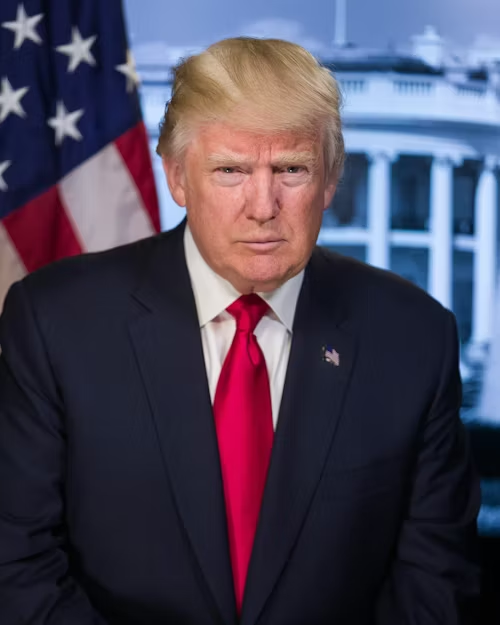
President Donald Trump centered his political identity on the slogan “America First,” which signaled his belief that U.S. interests should be focused on international engagement. However, amid recent foreign policy actions, such as military strikes against other countries and ongoing international conflicts, the question has arisen as to whether Trump’s actions still align with his campaign’s core principles.
During the 2016 presidential race, “America First” was a key element of Trump’s advancement in popularity, criticizing the past administration for excessive involvement in foreign wars, alliances and economic agreements that had supposedly not benefited American workers. The message resonated with the voter demographic that was frustrated by long-standing overseas conflicts and seeking a stronger focus on domestic issues such as economic growth, border security and infrastructure.
Yet, recent decisions have complicated this narrative. Military actions against foreign adversaries and continued US engagement in geopolitical conflicts such as launching military strikes against Iran, capturing the former Venezuelan President, landing strikes on suspected drug trafficking boats and placing global tariffs, suggest an eagerness to prioritize global security concerns.
Critics see these moves as similar to interventionist policies that Trump has spoken against. Supporters argue that in order to protect American interests, sometimes there must be engagement abroad as these tactical actions against threats align with the belief of “America First”.
From this viewpoint, limited military or diplomatic efforts abroad are essential for national security. Nevertheless, the disparity between Trump’s rhetoric and policy has sparked debate among voters and analysts. Some believe that international conflicts divert resources and attention from domestic priorities such as infrastructure, healthcare and economic inequity, which remain some of the top concerns for many Americans.
This debate emphasizes a broader challenge for U.S. presidents. As a global superpower, the country’s interconnectedness with alliances, trade and security arrangements often forces responses to international crises, even for those who campaign on reducing foreign engagement.
Abby Pomery (11) states, “I definitely find his actions to be quite contradictory. He has put far more intention into international power struggles and efforts that disrupt the nation like ice and disruptions to the education system. I think it has led to unnecessary conflict. While I do believe that places like Iran and Venezuela may benefit from intervention it is clear that the intention has nothing to do with care for the people of these countries. As a result, many lives have been unnecessarily sacrificed through bombings and such. Also, I fear that it is very clear he has little regard for the people as he does oil and economic gain.”
For some people, it is a bit difficult to connect the “America First” message to Trump’s recent actions overseas.
Mikhael Soto (12) states, “Some of the recent actions overseas seem a little questionable to me. If the focus is supposed to be putting America first, then getting deeply involved in conflicts around the world makes me wonder whether that goal is still the priority or if international power is becoming more important.”