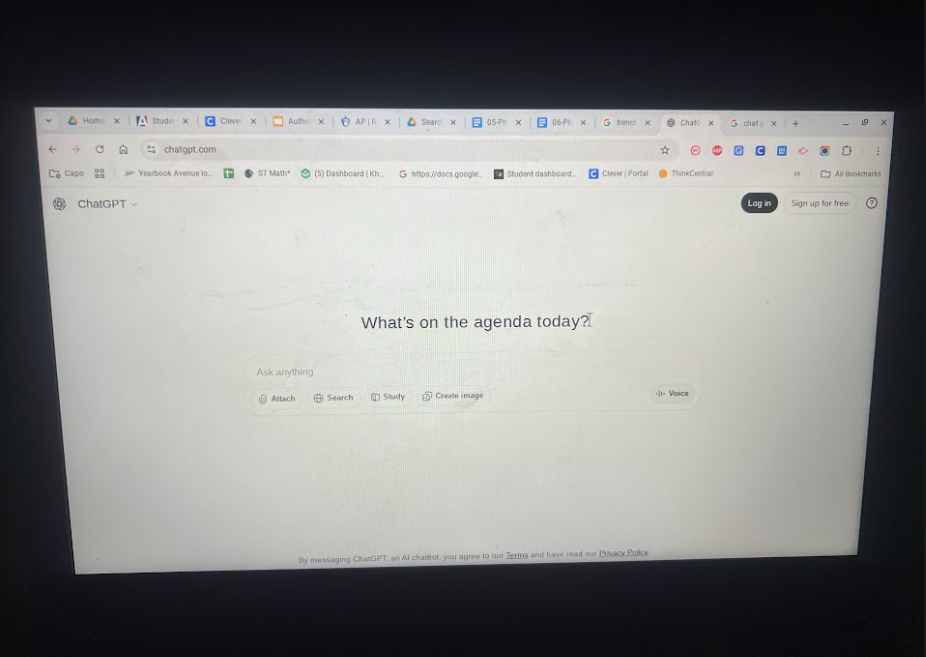
The expansion of the use of Artificial Intelligence has sparked controversies among many people, arguing whether its downsides are outweighed by its benefits. As more and more kids and adults begin to utilize AI in their everyday lives, people have strong opinions about AI and whether it is ethical to use.
One important thing to acknowledge when using Artificial Intelligence is that it can potentially spread misinformation. Due to the way the AI is trained, not all sources it pulls from are credible. When students or employees use tools like ChatGPT, they are susceptible to receiving false information, especially when they blindly copy down information without a thought.
Dr. De Diego, an AP Euro teacher at ANHS, says, “I think the biggest thing with AI is you have to be wise with its uses, and where you get its resources. You always have to double-check everything you use, because it can get things wrong very frequently.”
The use of Artificial Intelligence has become so normalized that students tend to follow it without a second thought. They copy and paste it for assignments, even essays and writing. This can be damaging to their learning process, as it engrains false ideas into their heads. This can cause students to remember it incorrectly and use this information in future work.
Even though some teachers use AI in their classrooms, De Diego states that she has utilized AI herself. Although she prefers to use information from her own brain and experience, she acknowledges that it can be a helpful tool in the classroom for difficult things.
She also sees the use of AI in her students, which she states can be both helpful and harmful to them. Many students in De Diego’s class use ChatGPT for things like term notecards to copy down definitions and the significance of different words. It can be helpful to compile relevant information.
One of the most significant arguments against the use of AI is whether or not it is ethical. JJ Lacanienta (12) says, “I do not think that the use of AI is ethical because it uses other people’s work and ideas, and encourages dishonesty in writing and other work.”
They point out a valid argument against AI. It takes products that took hard work from real people and gives them out from prompts that take seconds. This is offensive to many people, including artists and writers, because it takes away from all the effort they put into their work. This means that anybody has access to what everyone else made, which is a form of plagiarism. It is often said that everything will just become a cycle, in which AI material is then turned into more AI material.
The environmental effects from AI are also a con to its use, especially generative AI. Generative AI uses many resources from the Earth to produce prompts, which is a significant downside to its popularized use.
AI can be very beneficial to everyone, not only for work and school but also for things outside of it. It can give advice quickly in confusing and tricky situations on many topics. In school and work, it can create study guides, give dumbed-down explanations of concepts, gather information, and much more.
Despite its many downsides, the continuation of the use of AI is inevitable. Like any new technology, it will become more advanced and expand further. It is ultimately beneficial to society, even helping with important things like medical advancements. Therefore, it is more than likely to become the new “normal” just as other inventions have done in the past.